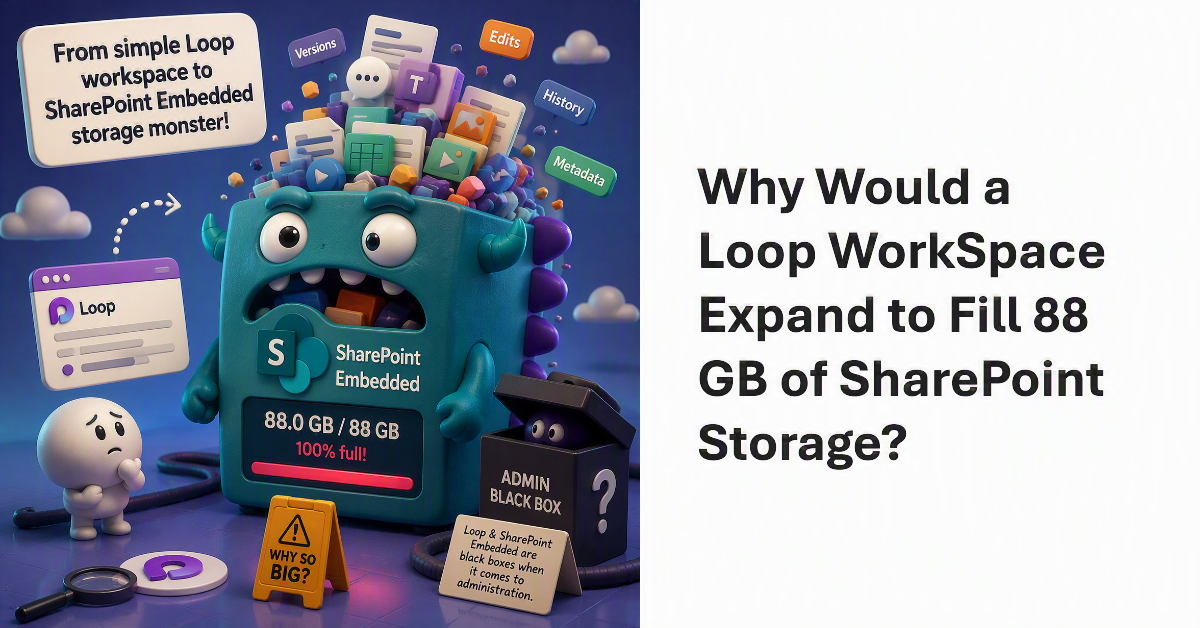
Why would a seemingly simple Loop workspace develop into a monster SharePoint Embedded container? That’s the question to answer when a Loop container grew to fill nearly 88 GB of SharePoint Embedded storage. The workspace had been through many hundreds of edits, but that’s an unlikely reason to spread and occupy so much storage. Loop and SharePoint Embedded are black boxes when it comes to administration, so we must wait for Microsoft to explain.
A set of 80 mysterious SharePoint Embedded containers turned up because Microsoft pre-provisioned storage for files used as knowledge sources by Copilot agents. Details of the pre-provisioning are in message center notification MC1058260, but who has the time to read and analyze everything posted to the message center? And anyway, the mysterious containers have now disappeared…
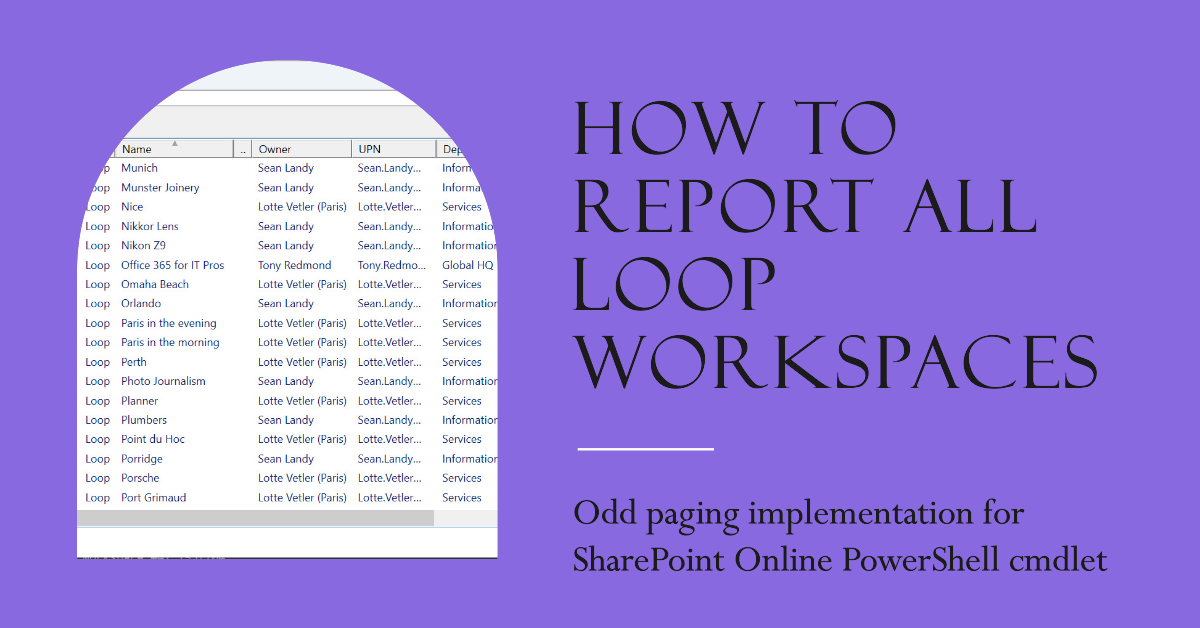
A previous attempt to write a script to report all Loop workspaces in a tenant was flawed because it only retrieved the first 200 workspaces. I hadn’t realized that the Get-SPOContainer cmdlet supported an odd form of pagination to retrieve workspace data. In any case, I figured out how to page top find all available workspaces and updated the script. It’s just another example of oddness in the SharePoint Online PowerShell module
SharePoint Embedded is a new Microsoft offering for application developers. The big upside is that apps can take advantage of the Microsoft 365 ecosystem. Cost is the potential downside. Microsoft will charge using a pay-as-you-go model, but estimating the likely cost could be difficult until more experience about how apps use SharePoint Embedded emerges.
When Microsoft released the preview of the Loop app, we figured out that Loop uses a special form of SharePoint Online to store its workspaces and pages. Now we know that Loop uses Syntex Repository Services (SharePoint Embedded), a new offering that allows apps to create storage partitions within SharePoint Online and use those repositories to store the files needed by the app. It’s still early days for both the Loop app and Syntex Repository Services (in private preview) and many operational details need to be explored, but the new offering is an interesting choice for app developers when it comes to deciding where to store their data.