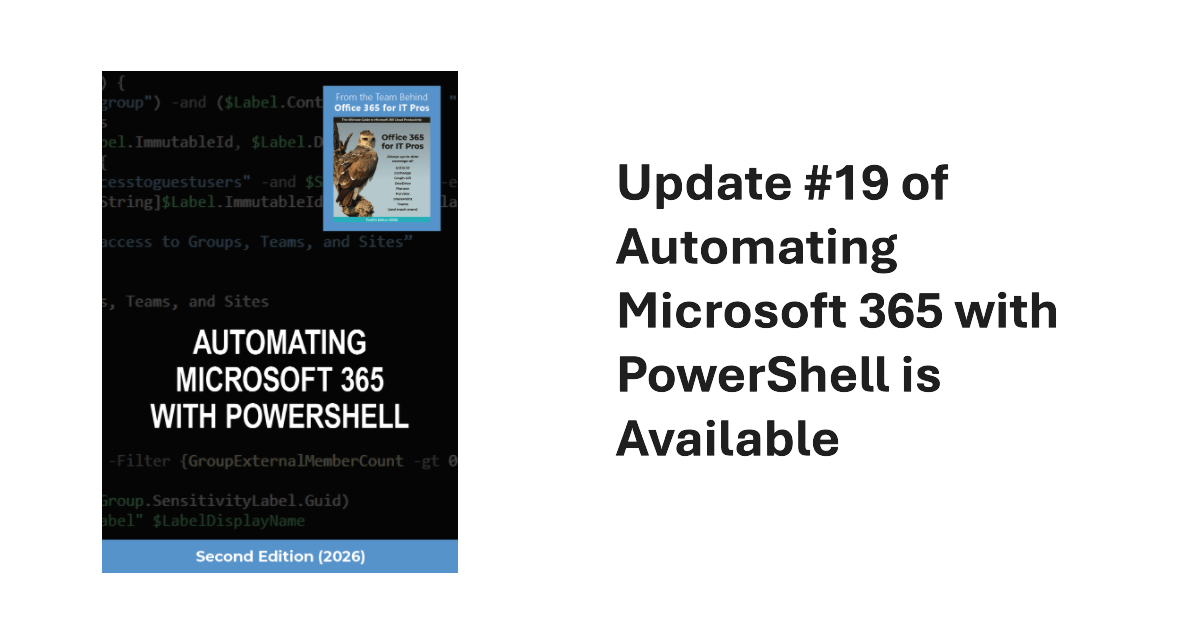
Update #19 of the Automating Microsoft 365 with PowerShell eBook is now available. Subscribers can download the updated PDF and EPUB files from Gumroad.com. A paperback version is also available, but we can’t update the print characters. In any case, a new SharePoint create Site API is in beta, and a new version of the Microsoft Graph PowerShell SDK is available. Both have their moments, as we discuss here.
Microsoft has launched a tenant-to-tenant migration orchestrator solution in public preview to migrate mailboxes, OneDrive accounts, and Teams chat between tenants. ISVs have been active in the T2T space for a long time. They probably won’t welcome the new Microsoft offering, but at least the migration orchestrator legitimizes the concept of tenant-to-tenant migration.
A new Exchange Online feature allows administrators to remove multiple types of holds from mailboxes (usually inactive mailboxes). It’s a great way to release holds that might be keeping inactive mailboxes lingering in a tenant. The feature doesn’t remove holds used to retain items required for eDiscovery or other compliance purposes. Even so, this is definitely a feature that needs to be carefully tested.
Microsoft is launching version expiration policies in SharePoint Online for audio and video files. The approach is the same as used for intelligent versioning of Office files stored in SharePoint Online and OneDrive for Business and can be configured at the tenant, site, and document library level. If your tenant uses Clipchamp, this could be a way to save expensive SharePoint storage.
Exchange Online will require email clients to use Exchange ActiveSync (EAS) V16.1 to connect from March 1, 2026. Email clients that use older versions of EAS won’t be able to synchronize with Exchange Online to upload outbound messages or download messages, attachments, and calendar items. There should be relatively few clients using an old version of EAS, but it’s wise to check.
Microsoft has released a set of security benchmark recommendations for Microsoft 365 tenants that it calls baseline security mode. The recommendations cover authentication, file access, and Teams and the idea is that these are settings that Microsoft believes have proven their value over the years. The only criticism that you might have is about the potential clash for conditional access policies, but that’s not serious.
After the fuss around the initial introduction of the Anthrophic models into Microsoft 365 in September, we learn that Microsoft will enable access for all in January 2026. It would have been so much better had Microsoft said that they were working on the data protection arrangements with Anthrophic, but that didn’t happen. Is all well now? We’ll see in January…
The MCP Server for Enterprise is one of a set of preview servers released by Microsoft to show how MCP servers can help Microsoft 365 tenants get real work done. I’m sure things will improve, but the current state of the preview is that it can do a splendid job to answer simple questions, but once things get more complex, don’t depend on any of the PowerShell code the server generates.
The addition of Autocorrect for messaging is a small but important change for Teams messaging brings Teams up to speed with the other Office applications. It’s taken Teams a little longer than it perhaps should have to support Autocorrect and the implementation is not as functional as it is in Outlook, but that’s not a reason to overlook the update.
After all the fuss about Teams users inviting people to chat via email, tenant administrators realize that knowing where users are active as guest accounts is not as easy as it might seem. Part of the problem is that data about user activity is mostly controlled by host rather than home tenants. However, it’s possible to extract some information from audit sign-in logs to figure out where tenant users go as guests.
Customers will see their bills increase from July 1, 2026, when Microsoft 365 pricing increases go into effect, adding up to $3/month for licenses. This is the first increase since March 2022, and it moves the baseline Office 365 E3 license to $26/month and Microsoft 365 E5 to $60/month. Microsoft justifies the increases based on the functionality and apps it delivers. Time for a licensing review!
A December 2 announcement says that Exchange Online will block access to Exchange Web Services for users with kiosk or frontline worker licenses from June 2026. In fact, the Exchange Online service description has always excluded EWS access for these licenses, but the necessary code to enforce the exclusion was never implemented. It will be in March. Time to check licenses…
Microsoft recommends passwordless authentication to help secure Microsoft 365 tenants. The latest is synced passkeys, something that apparently leads to “syncability,” whatever that might mean. In any case, after some struggles, I managed to enable synched passkeys for my iPhone and then started to consider how to remediate user accounts that are flagged with a high-risk (compromised) status when they can’t simply update their password.
Paul Robichaux and I led a session about Microsoft 365 Compliance at the European SharePoint Conference in Dublin on December 2, 2025. During the session, we discussed how intelligent versioning works and its value in saving storage, priority cleanup and its ability to delete files even if the files are under retention hold, and the recent revamp of the Purview eDiscovery solution. We were thrilled at the attendance. Here’s what happened.
The latest versions of the SharePoint Online PowerShell module support app-only authentication (certificate-based authentication) for the Connect-SPOService cmdlet. In other words, applications can now connect to SharePoint Online to run administrative cmdlets by presenting a registered Entra ID app and an X.509 certificate instead of the credentials for a human SharePoint administrator. It’s a good change, even if I still prefer using the Graph APIs for SharePoint automation.
The Office 3675 for IT Pros team is happy to announce that the files for update #126 are available for subscribers to download from Gumroad.com. The paperback edition of the PowerShell book has also been refreshed. Updated PDF and EPUB files are available for the Office 365 for IT Pros and Automating Microsoft 365 with PowerShell eBooks. Happy reading!
Some weeks ago, I wrote about using a transport rule to suppress spammy email by sending the messages to the quarantine. But what’s the best way to check the rule’s effect? One method is to use the transport rule report PowerShell cmdlet to check for the actions you expect the rule to perform. Once information is found, it’s a matter of slicing and dicing the data.
Shared mailboxes might need Microsoft Defender for Office 365 licenses, but how do you identify how many licenses? We use PowerShell to do the job by analyzing external email sent to shared mailboxes. If a mailbox receives external email, then by definition the mailbox receives benefit from MDO, and that’s the test for requiring a license.
Teams now includes weaponized file protection and malicious URL protection to make sure that people don’t share bad files or URLs in chats or channel conversations. Given that a user can post a message to up to 50 channels at one time, it obviously makes a heap of sense to check that any files or URLs that people share in chat or channel conversations are safe and not malicious.
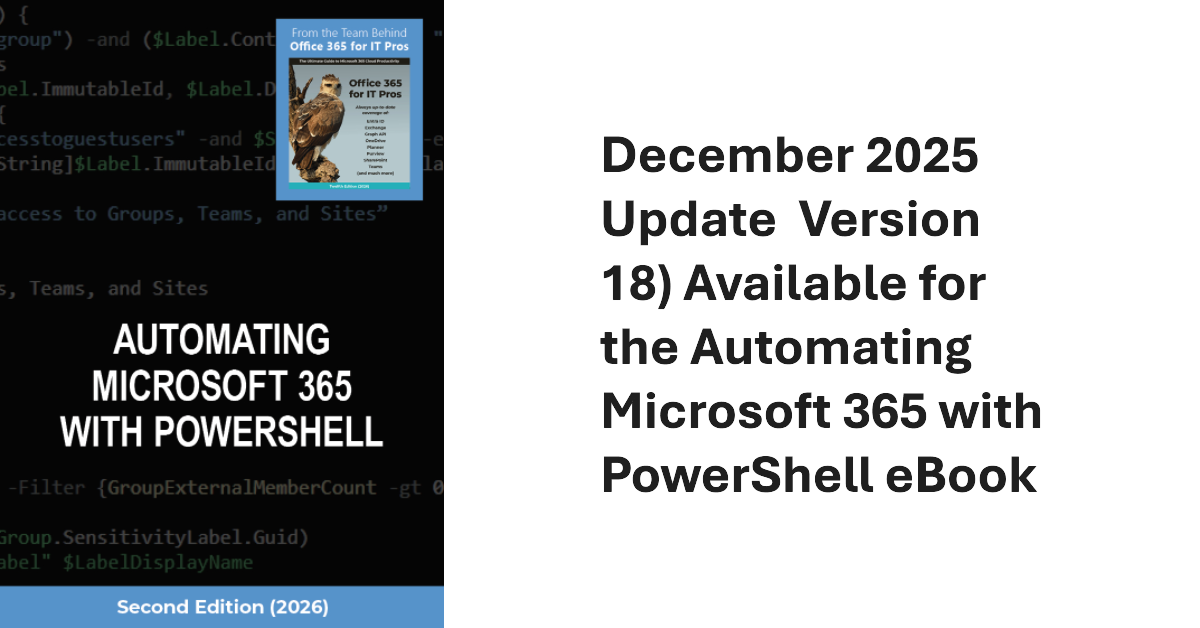
The December 2025 update (version 18) of the Automating Microsoft 365 with PowerShell eBook is now available to download. Current subscribers can fetch the updated EPUB and PDF files from Gumroad.com using the link in their account (or receipt), but we can’t do much for the paperback edition except consider using scissors, paste, and Tippex, just like the old days.
A new DLP policy for Copilot prompts monitors blocked sensitive information types like credit card numbers to stop their use in Copilot prompts. The new policy can’t be combined with the existing DLP policy for Copilot, which checks for files with specific sensitivity labels to prevent Copilot from using their content in its responses. But that’s OK because the two policies do very different work.
The Ignite 2025 keynote was a marathon 150-minute event, but some interesting Microsoft 365 announcements emerged, mostly centered on AI. Microsoft is obviously focused on making AI and agents a very real part of tenant activities, so there’s new agent management and a repository among other things that will roll out in the year ahead.
Microsoft launched the preview of the Exchange Admin API on November 17. The new API is intended to close known feature gaps that exist in the Graph APIs and allow developers to migrate from EWS before Microsoft retires EWS in October 2026. Think of the Exchange Admin API as a discardable time-limited API that allows clients to submit cmdlets for processing. It’s certainly one way to approach the EWS problem!
The Entra ID Governance solution includes a workflow to detect and remove inactive user accounts. Sounds good, but the same can be done with PowerShell if you want to avoid the cost of Entra ID Governance licenses or want to create a bespoke workflow that’s better suited to the business needs of the organization. Azure Automation would be a good way to process this workflow.
A temporary chat with Microsoft 365 Copilot is one that forgets everything discussed in the conversation once the chat is over. The idea is that by leaving no trace, Copilot won’t recycle the ideas discussed in the chat later. Copilot absolutely discards the chat thread, but those pesky compliance records remain behind, ready for eDiscovery and other compliance investigations.
In January 2025, Microsoft changed the SharePoint folder location to store copies of the email sent to Teams channels. Apparently, this update improved security, but it’s unclear exactly how the improvement comes about unless through obscurity. In any case, we missed this change completely and are publishing this note to remind everyone else of the importance of reading message center posts.
The question was asked if it was possible to identify use of the Claude LLM by the Copilot Researcher Agent. Audit records often help, so that’s the natural location to check. As it turns out, some information is captured when the Researcher agent is used, but figuring out if the agent uses the default ChatGPT-5 or Claude LLMs is a matter of intuition (or guesswork).
Entra ID has long supported soft-deleted Microsoft 365 Groups. Now support is available to list and restore soft-deleted security groups in both the Entra admin center and cmdlets from the Microsoft Graph PowerShell SDK. The update is very welcome as it fixes a big recovery gap in the Entra ID story. Too many important security groups have been deleted in error, much to the chagrin of administrators.
A new Teams feature allows users to initiate chats with any email address. This caused some commotion in the security community, but it’s not that bad. In fact, it’s an extension of existing functionality that allows Teams users to chat with guest accounts. All that’s happening is that initiating a chat causes a new guest account to be created in the tenant, and there’s lots of controls to make sure that guests are controlled.
This article explains how to use PowerShell to extract audit data to analyze the use of emojis as Teams reactions to chat and channel messages. This is not an exercise that leads to any great business value, but it’s a good way to show the sometimes surprising data that can be extracted from audit records.
The Microsoft 365 User Passwords and Authentication report now includes the last used date for authentication methods (when available). The new data is available through the Graph beta API for listing authentication methods and the equivalent Graph PowerShell SDK cmdlet. Another change that might break scripts is a new way to expose the created date for authentication methods. The changing sands of Graph programming…
Microsoft 365 Companion Apps are being deployed to Windows 11 PCs now. The apps don’t seem to add much if any value over standard Microsoft 365 apps like Outlook and OneDrive. With that thought in mind, we move to unclutter PCs by either blocking the installation of the companion apps or stopping the apps starting up to take over valuable toolbar space.
A recent report says that new Microsoft leadership wants to reimagine Outlook with lots of many AI features to make the client much more of an effective assistant. While this might be true, it doesn’t mean that New Outlook is dead. However, there’s a bunch of uninformed commentary out there alleging that Microsoft will change course dramatically. I think there is little chance that this will happen.
The Office 365 for IT Pros Team is happy to announce the availability of the November 2025 update. Subscribers can download the PDF and EPUB files for update #125 from Gumroad.com. In other news, we consider the lack of information provided at the Microsoft FY26 Q1 results and the quality of some reports that find their way onto the internet.
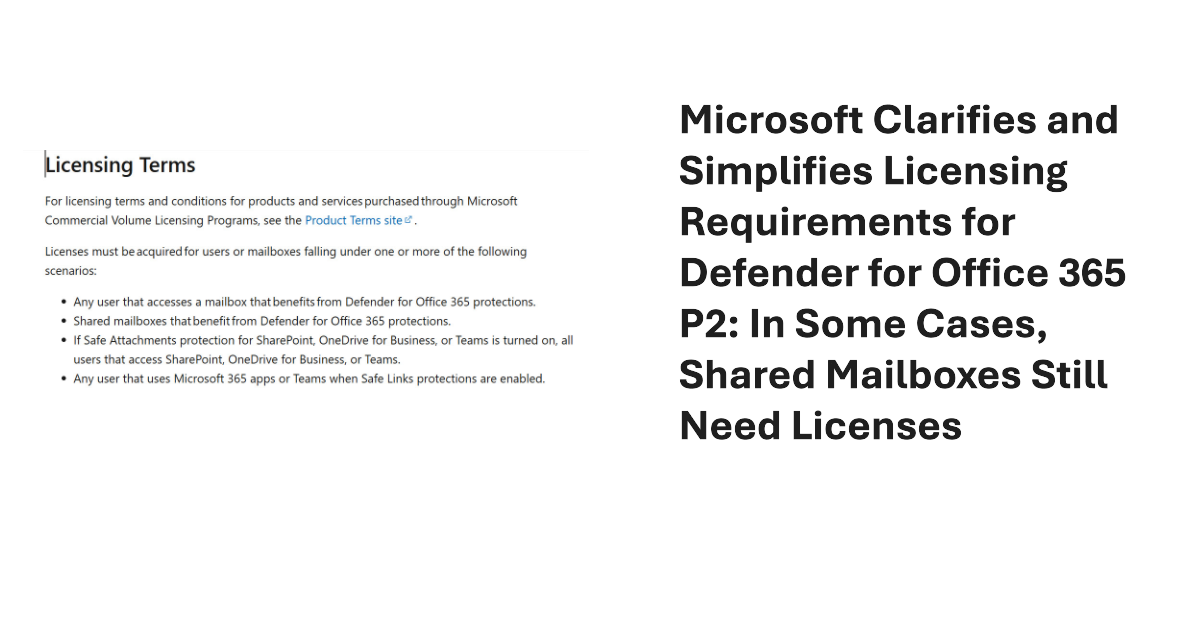
Some inconsistencies in the MDO P2 service description and licensing terms exposed a need for tenants to license every user and shared mailboxes. Microsoft has changed the service description and licensing terms to make them simpler. Mailboxes still need MDO licenses, but only if they benefit from MDO protection, including MDO P2 if that’s what they use. Tenant admins have some extra work to do to deploy policies. All explained here.
The site attestation policy is designed to require site owners to make a positive statement that the settings of their site, including its current membership, are accurate. The idea is that requiring site owners to attest that their site is still needed will force people to decide whether sites are still in active use and should be kept online. If not, the policy can move the sites into Microsoft 365 Archive.
Microsoft announced the modernization of grouping for sensitivity labels to a new “dynamic architecture.” It doesn’t take much to be more dynamic than the previous parent-child arrangement. Even if the announcement is a tad overhyped, it’s still goodness because administrators can now move labels between label groups in a way that wasn’t possible before. The new way of displaying labels should be everywhere in December 2025.
As is the way of the internet, the news that a feature to automatically set the Teams work location for users created a huge fuss about the prospect that managers would keep an eye on employees based on their location. Of course, this is all rubbish. The update automates an existing feature that no sane manager would use to monitor employees.
Teams stores information in a local state file, including encrypted access tokens. A report from a French company explained how to extract and use those tokens with the Graph API. Is this important? It could be if attackers manage to gain access to a workstation, but at that point you’ve got other problems, and maybe using code to decrypt some tokens is the least of your troubles.
Enterprise apps can come from a variety of sources. Most are Microsoft 1st party apps, and the rest are ISV apps. It’s easy to add an app without really intending to, which is a good reason to force users through the Entra ID app consent workflow when they want to add an app. Unhappily, I failed the test and added an app in a moment of weakness. Here’s what happened.