Attendees of Teams meetings now have the ability to share their opinion of the proceedings through live reactions, a set of emoticons ranging from thumbs-up to laugh. Reactions appear on attendee cards or float up from the bottom of the screen when material is beiing shared. Tenants can disable reactions uising Teams meeting policies, but meeting organizers can change meeting settings to allow reactions in specific events. Although it seems like a feature that doesn’t add much for a business user, reactions have their place – if used intelligently!
Now deployed to Office 365 tenants, large Teams meetings can support up to 20,000 view-only attendees, if an organization chooses to update its Teams meeting policies. Interestingly, this is a feature which Microsoft originally planned to license under its Teams advanced communication add-on, but the growth of large meetings in organizations might have forced their hand to bring the feature to mainline Teams.
Teams desktop clients are being updated with a new history menu to reveal the last 20 locations visited by a user in their Teams session. It’s a much faster way to get back to something than the older back arrow method. Another example of how Microsoft is refining the Teams client UI to remove little bits of friction and make everything work more smoothly. Or so they say.
Microsoft is changing the way new teams are created in the Teams admin center to make sure that their settings are consistent with teams created in other interfaces. It’s a good idea because it means that all teams are then created equal. Organizations who wish to use different settings can update teams once they’re created using either PowerShell or the Graph API.
Microsoft is giving the Teams desktop and browser clients a makeover with their Fluent design system. If you look closely, you’ll see some changes in app icons, but the other changes are too subtle for many, including me. Up on the upside, while those of us who write about Teams will have to refresh some illustrations, the documentation for the Fluent design system is an interesting read. Well, it is late at night when you’ve nothing better else to do…
There are many examples of PowerShell scripts which create reports about the membership of Microsoft 365 Groups. Most are slow. This version is faster because of its per-user rather than per-group approach to processing. The output is a nice HTML report and two CSV files containing a list of memberships in Microsoft 365 Groups and summary data for each user in the tenant.
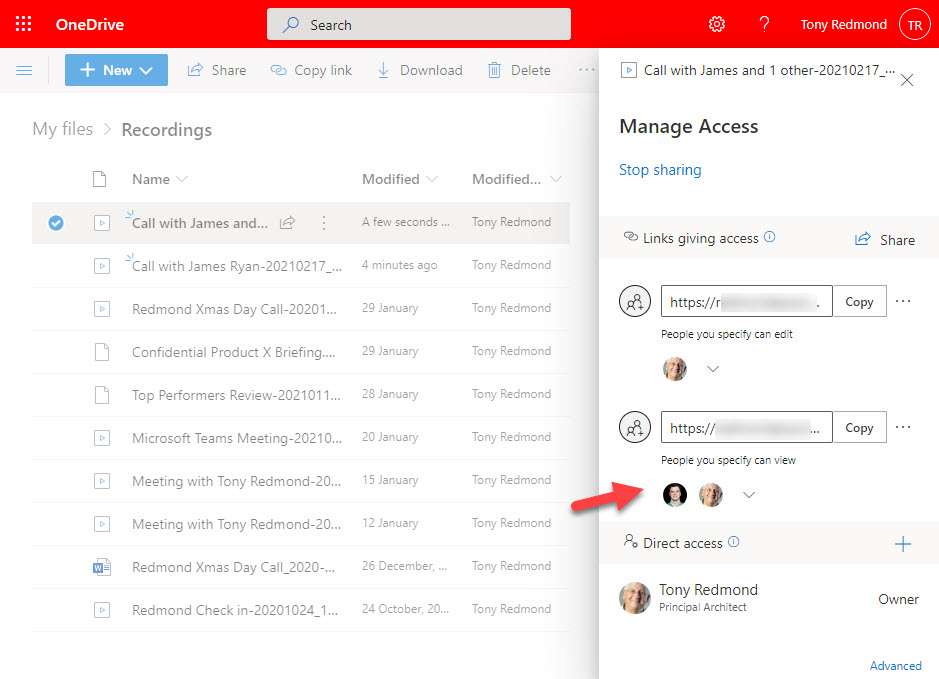
Microsoft has announced that recordings of Teams meetings stored in OneDrive for Business will be blocked for download by anyone except the owner. The change will roll out in mid-April and should be complete by mid-June. Microsoft’s post draws attention to the fact that you shouldn’t use channel meetings to discuss confidential topics. It’s all to do with the Microsoft 365 Groups membership model.
Many people want to print off membership details of Microsoft 365 groups, which makes it curious why Microsoft doesn’t support the option in Teams, OWA, or other applications. Fortunately, it is very easy to extract and report membership with PowerShell. Here’s how to generate a HTML report with a CSV file on the side.
The Teams desktop and browser clients are gaining an offline send capability. Messages sent offline are queued locally and go when the network reappears. Connectivity must be resumed within 24 hours. If not, users need to review the messages to make sure that it still makes sense to resend them.
The Microsoft 365 substrate now captures Teams app card data in compliance records to make the data available for eDiscovery, content searches, holds, and retention. The compliance records are stored in user and group mailboxes. Audit records for card interactions are also logged in the Office 365 audit log. Using compliance records means that some app data context is lost, but at least you can find the information.
A change made to the storage location in SharePoint Online for email sent to Teams channels caused problems for people who created Flows based on a known location. Instead of having one big folder for email messages sent to a folder, it seems like Microsoft plans to use a new folder for each month. There’s nothing wrong with this approach, but it would have been nice if Microsoft warned people using the folder for automated processing that a change was coming. They didn’t.
Microsoft has updated the format of the Teams attendance report to include more data about who attends meetings. The new report is persistent and available after a meeting ends. The new format will no doubt be popular with teachers who need to track who attends their online classes, but it’s likely to be also popular in the enterprise for those who organize meetings with mandatory attendance.
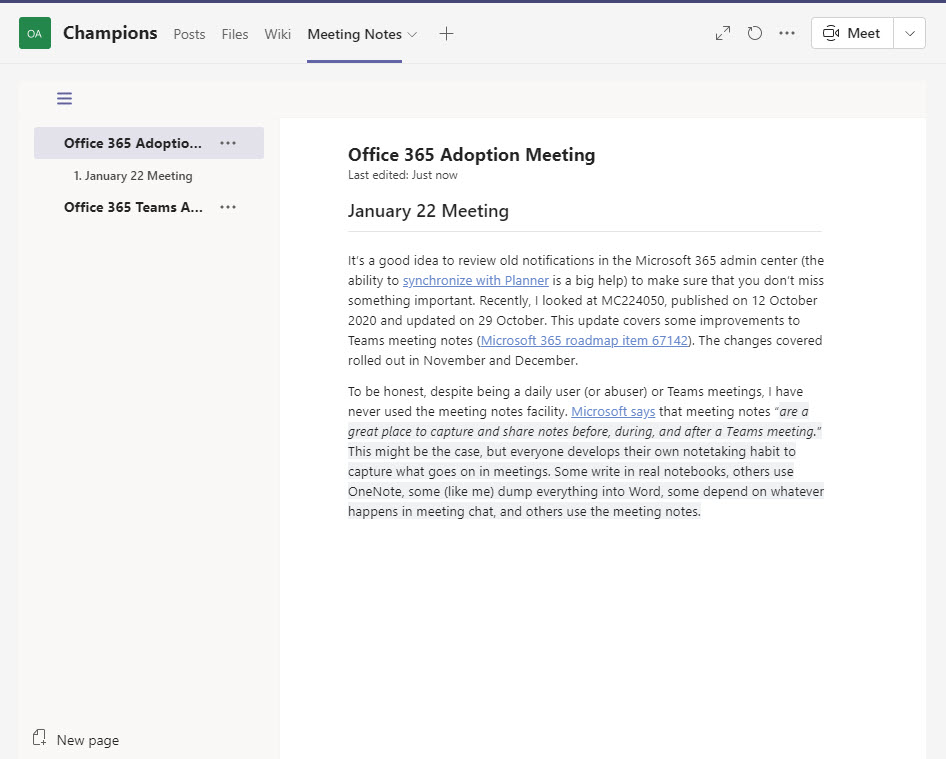
Teams meeting notes are a form of the Teams wiki with much the strengths and weaknesses of the wiki. Good enough for small meetings but limited for larger gatherings when you’ll probably want to capture details using a tool like Word or OneNote.
The inbound webhook connector used by Teams and Microsoft 365 Groups to accept information from external sources is getting a new format. Existing connectors must be updated by April 11, 2021. If not, data will stop flowing into the target channel or group, and that would be a bad thing.
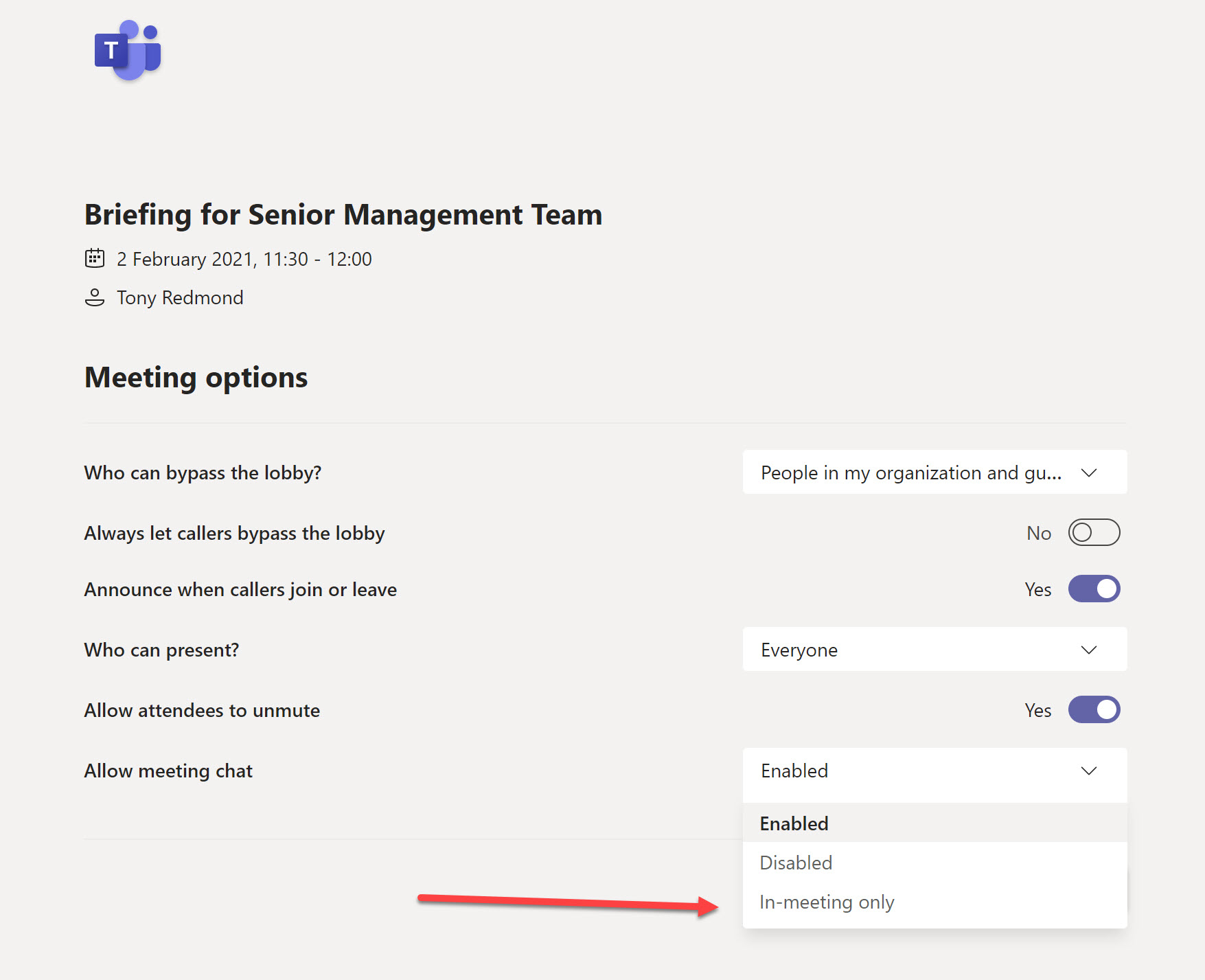
A new control over Teams meetings allows meeting organizers to choose if participants can chat before, after, during, or not at all. Stopping people chatting during online meetings is one way to try and keep their attention, but this feature is likely to be more popular in education than in the enterprise.
Setting a daily status message in Teams is a great way of keeping your coworkers informed about your overall availability during the coming day. Another tip to consider is to advise people who want to chat with you that they should start the conversation in a meaningful way by setting the context. Don’t start chats with Hi or Hello.
Teams Data Loss Prevention (DLP) policies help to stop users sharing confidential information through chats and channel conversations. A recent update means that accounts to be included or excluded in DLP policies can be specified using distribution lists or mail-enabled security groups. While this doesn’t sound very exciting, it is if you need to deploy DLP policies to targeted sets of Teams users.
Feb 24 2021 Update: The picker used for OneDrive for Business accounts will support distribution lists and security groups in March.
You can create an Azure AD Access Review for all guests in teams and groups in your tenant and then see what’s happening with the Graph API. In this case, we use PowerShell with the API to grab the access review data and create a report about the overall status of the review in a tenant.
A new setting for Teams meetings allows organizers to limit the ability to bypass the meeting lobby to people explicitly invited to the meeting. Precise control is important when you set up meetings to review confidential or sensitive data. After all, you don’t want anyone who gets a copy of the meeting link turning up to listen in to what’s going on.
The Teams meeting recap feature highlights some of the important resources which can be generated for meetings. The recording, transcript, and attendance report are displayed under the Details tab for meetings accessed through the Teams calendar app.
Outlook for Windows is gaining a new Meet Now button in the Teams meeting add-in. You can use the add-in to launch impromptu private Teams meetings. That is, if the settings in the Teams meeting policy assigned to your account allows. And guests better not try to Meet Now when they’re signed into a host tenant because they’ll probably end up frustrated down a black hole, which is a horrible place to be.
The Teams channel calendar app highlights meetings scheduled for a calendar and makes it easier for team members to attend these events. Meetings for all channels in a team are stored in a single calendar, so the app applies a filter to display the meetings belonging to the channel it is installed into.
The Teams meeting add-in allows users to schedule online Teams meetings from Outlook. While you might know that the add-in exists, do you know how to find its version number and where the add-in DLL is stored? These questions and others are answered in this post.
Long-term Outlook users have probably noticed that they can’t attach files in events created as Teams meetings. Teams like cloudy files, not email attachments, so if you want to send some important information along with a meeting invitation, you can include links to the data or paste it into the body of the invitation. And once the meeting is created, you can share files with meeting participants, which is really the Teams way of getting the job done.
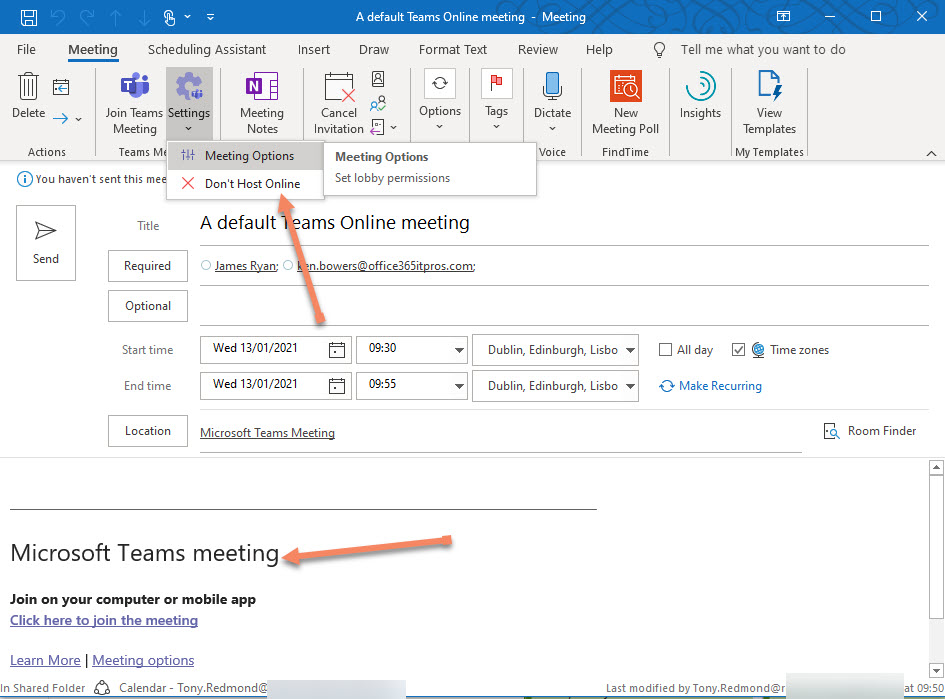
Outlook for Windows has the option to make Teams online meetings the default for all new meetings. Users can edit meeting settings through Outlook too. Unlike the other Outlook clients, Outlook for Windows depends on a registry setting to control whether an online event should be created. And there’s no support for third-party meeting platforms.
Bing publishes a new image daily in its home page. You can download the images and use them as custom background for Teams meetings. A PowerShell script automates the task and downloads the images for the last seven days and cleans up any Bing images older than 30 days.. It’s a nice way to use some attractive images to liven up Teams meetings.
The format of the Teams compliance records generated for personal and group chats and stored in Exchange Online mailboxes is changing. Microsoft is removing a bunch of unnecessary attributes from the records to reduce the processing load on the service to retrieve the attributes from Azure AD. The change is unlikely to affect most tenants. Compliance records for older chats are not affected.
Microsoft will retire the Skype for Business Online (PowerShell) Connector on February 15, 2021. Office 365 tenants need to check scripts to replace the connector with the Teams PowerShell module, which contains the necessary cmdlets to connect to the policy management endpoint. Once connected, scripts can interact with objects like Teams messaging and meeting policies.
The Microsoft Teams Meet Now feature is now available in mobile clients and can be used to start impromptu meetings from a user’s calendar or in a channel. Tenants can control the ability of users to schedule Meet Now meetings with a Teams meeting policy where settings are available to control meetings scheduled from the calendar or a channel.
Organizers and presenters of Teams meetings can add simple polls created with Microsoft Forms to collect feedback and information during meetings. It’s a small but useful improvement which will add value to many meetings in the education and other sectors.
A new Graph API and the Teams AadSync process improve how Teams synchronizes group membership information with Azure AD. The older background sync process was tied to the Teams client and didn’t work so well in practice, especially when scaled up. Things look good for the new mechanism.
Microsoft says that SharePoint Online now has 200 million monthly active users. Teams is the major influence driving SharePoint growth with an increasing number of touchpoints between the two Microsoft 365 workloads.
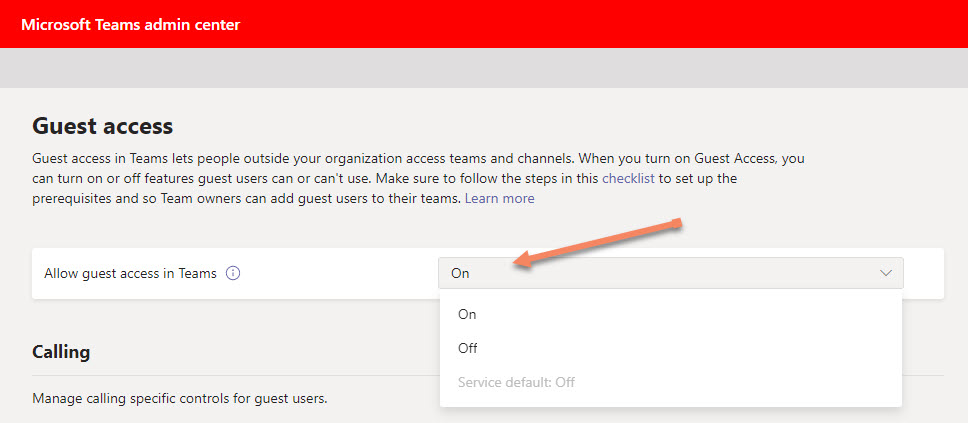
Microsoft is changing the default setting for guest access to Teams from Off to On. This won’t affect tenants already using Teams, but it’s a good opportunity to review how guest access is used in tenants and consider whether existing guest accounts are needed or can be removed. This post offers some ideas about using policies to control guests and how to check what these accounts are used for.
A recurring meeting is a series of events. For Teams, each event might be different, but all events share the same online workspace. The advantage for this approach is that the participants see resources shared for all meetings; the downside is exactly the same because some people might not want this to happen.
In mid-March 2021 Microsoft will switch control over Teams 1:1 meeting recording from meeting to calling policies. By default, this stops users recording 1:1 meetings, meaning that tenant admins will have to update the default calling policy and any custom calling policy to allow recordings to continue. Of course, you might think it a bad idea to allow people to record 1:1 calls, in which case you don’t need to do anything.
Teams supports the ability to allow selected users to enable Public Preview features in the desktop and browser clients for an early view of functionality. You’ll need to create a new update policy in the Teams admin center and assign it to the people you want to access public preview. It’s all very easy and very useful, which is nice.
Browsing a Teams configuration file uncovered a reference to a blueberry. There’s no obvious link between Teams and a small fruit, so it’s some form of in-joke among the product designers or developers. A point of trivia for a holiday Friday!
Participants in Teams meetings can use the meeting chat to discuss topics, post pointers, and so on. The access rules are changing for some added to a meeting to make sure that people don’t get too much access to meeting resources (like chat) once the meeting finishes. It’s a small but important point for Teams administrators to understand.
Outlook for Windows has a Groups menu bar which is displayed when conversations in a Microsoft 365 group are accessed. A new Teams button is available to bring users to the General channel of team-enabled groups. It’s an interesting decision by Microsoft to add the button because I am not quite sure if any need exists for such a facility.
An update to the Teams Windows and Mac clients introduces automatic noise suppression for Teams meetings. You can tune suppression up or down to reflect your environment. The feature works by analyzing the audio feed from the microphone used in a meeting and removing unwanted noise. The more suppression is done, the more resources are used, so this is something to keep an eye on.