The June 2020 update for Office 365 for IT Pros, the world’s best and only constantly updated book about Office 365 is now available. Subscribers can download updated files from their Gumroad account. If you’ve bought the Kindle version from Amazon, you can ask them for the updated files.
Microsoft Stream will tell you how much of the tenant storage allocation has been consumed by uploaded videos, but not who’s uploading the videos. You can find out by looking for video upload events in the Office 365 audit log. Once found, it’s a matter of processing the events to extract useful information!
Changes coming in May and June will allow organizations to make online meetings the norm when created by OWA or Outlook mobile clients. You can control the feature at the organization level and allow individual mailboxes to override the organization setting.
A new setting available in Teams meeting policies allows Office 365 tenants to have per-user control over who can present at meetings. You might want to do this to stop guests presenting. or to limit some people from inviting others to present. I’m not quite sure what the use case is, but no doubt some people will find great value in the new setting.
I’ve written many articles to explain how to use the Office 365 audit log to report different aspects of the platform. But taking action is much better than just reporting. In this post, we explain how to take a report generated from the Office 365 audit log and use it to drive some actions. In this case, removing the SendAs permission from people who aren’t using it.
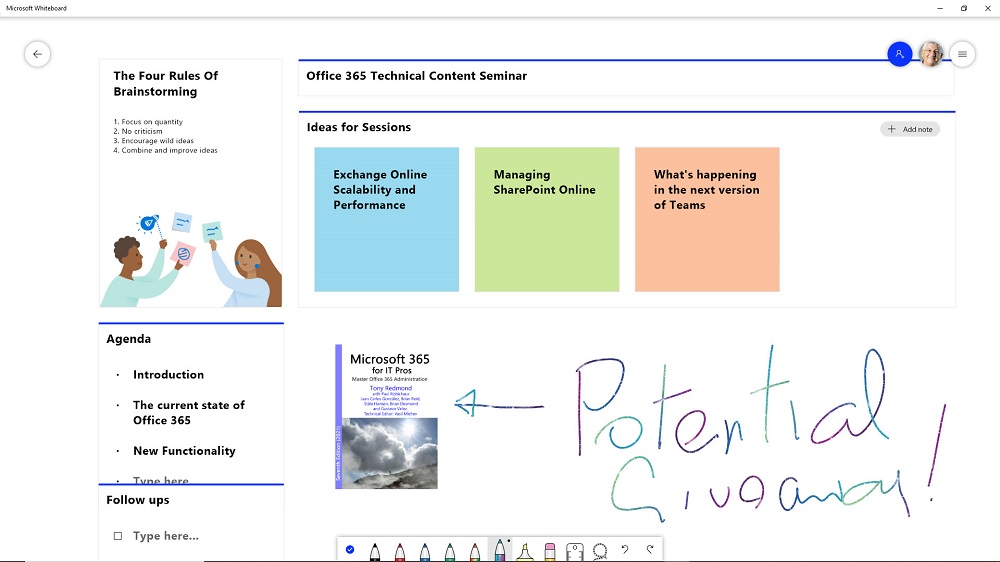
Whiteboard is a digital canvas application that can be loaded into Teams meetings to allow participants to share and develop ideas. The app available in Teams isn’t the most functional way to interact with Whiteboard, what whatever version you use can draw and sketch ideas to share with team members and other people within an Office 365 tenant.
Support for sensitivity labels is generally available for SharePoint Online. Users can apply labels to classify and protect documents, but a mismatch can happen between labels applied to documents and the sites where the documents are stored. When this happens, SharePoint Online emails site owners to tell them that a mismatch exists.
For compliance purposes, the Microsoft 365 substrate captures copies of Teams messages in Exchange Online mailboxes. The compliance records are indexed and discoverable, which means that they can be found by content searches. However, Teams compliance records are imperfect copies of the real data, which is a fact that seems to have escaped many people.
Outlook for Windows is soon to support roaming signatures, but only the click-to-run version when connected to an Exchange Online mailbox. Still, it’s progress, and it will make the task of using the same signature on different PCs much easier. Good-looking signatures must still be generated for corporate branding purposes, so the ISVs selling email signature products don’t need to fret.
The new screen capture option is available in Microsoft Stream worldwide. You can capture a window, browser tab, or a complete screen and have the content uploaded and processed by Stream. The feature handles short (15 minute) videos and it’s a nice way to capture lessons, how-to demonstrations, or even bug reproductions.
An item in the Teams release notes tells us that analytics are now available for channels. You can find out how many topics and replies are posted within a channel. You’ll probably know what channels are in heavy use anyway, but seeing how little traffic some channels get is a good way of knowing that maybe your teams don’t need those channels.
SharePoint Online generates a lot of events in the Office 365 audit log. You can interrogate the log with PowerShell to create per-user reports of their activities. The Search-UnifiedAuditLog cmdlet finds all the necessary data; after that it’s just a matter of filtering and refining the data and then creating the reports.
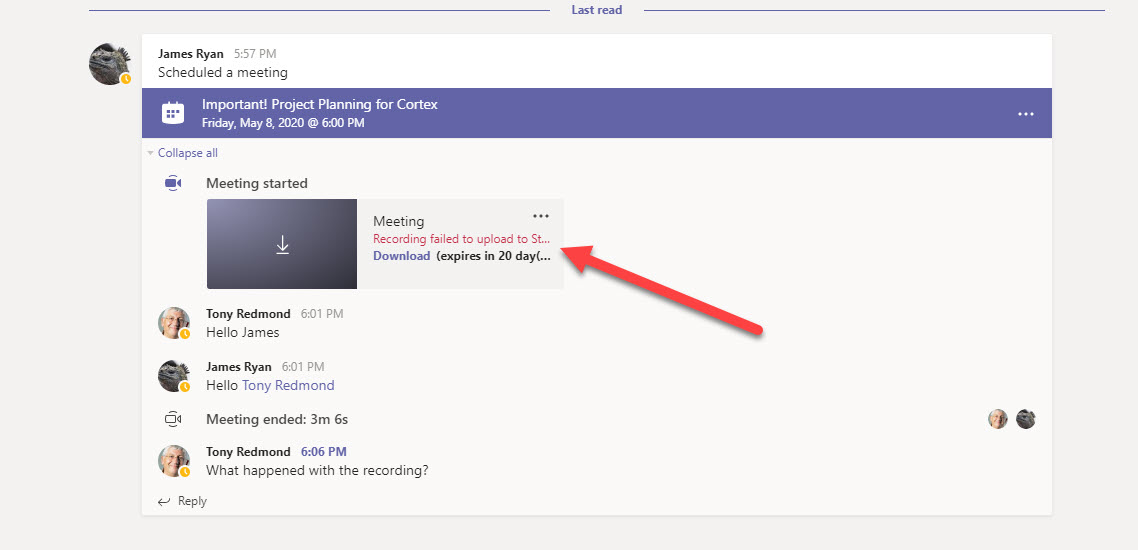
It’s very convenient to be able to record a Teams meeting and have the recording processed and stored in Stream. But what happens when the recording fails to be processed? Usually it’s because the account that starts the recording (the owner) doesn’t have a Stream license. Fortunately, the situation is easily rescued.
Microsoft has updated the Teams meeting policy to introduce a new control over video filters in Teams meetings. The VideoFiltersMode setting controls if people can use background blur and background effects, including the ability to upload custom images. A client update is needed to respect the new setting. It will come at the end of May.
Microsoft has published updates for the Exchange Online management and SharePoint Online PowerShell modules. Generally it’s a good idea to install the latest version of PowerShell modules for the different Office 365 products, but beware of some gotchas that await the unwary…
It’s easy to retrieve storage data for SharePoint Online sites with PowerShell, but it’s faster with the Graph. Some disadvantages do exist, but it’s nice to have a choice. TheGraph is faster, especially with large tenants, but the SharePoint Online PowerShell cmdlets can deliver more data.
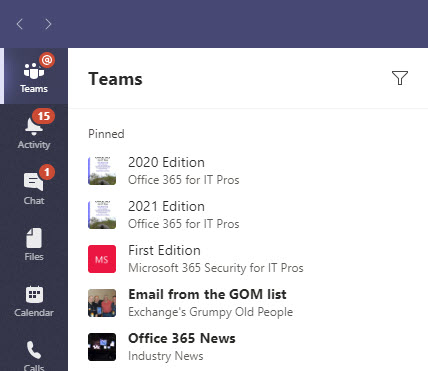
Teams is a highly functional application that receives regular functionality upgrades. This post offers seven tips for making effective use of Teams from pinning important objects to making great video calls. All very practical and nothing too difficult to master.
Microsoft has announced that Stream will no longer create a people timeline in new videos it processes after June 1 and that the feature will be retired. The people timeline feature works well for videos taped in controlled conditions, like studios. It is less successful (and useful) for recordings of Teams meetings, which is where a lot of work for Stream comes from currently.
PowerShell modules are often updated regularly to add new features and functionality. When the time came to update the Azure Active Directory preview module to 2.0.2.89, things didn’t work so smoothly because the files for the previous version of the module had ended up in OneDrive for Business. The moral of the story is that there’s a reason why the Scope parameter exists for the Install-Module cmdlet.
Microsoft announced on May 1 that the limit for Teams group chats is increasing from 100 to 250. The new limit will be available everywhere by mid-May. Nice as an expanded limit it, large group chats come with some notable decreases in functionality, like losing the ability to display user status messages or read receipts. In some cases, taking a conversation to a channel might be a better idea.
Several updates are available for the standard usage reports in the Microsoft 365 Admin Center. One helps Office 365 tenants understand the changed user activity profile due to remote working. Another gives views of user activity across the complete tenant. The updates are useful and interesting, but an ISV product will do a better job of analyzing and reporting the same data.
Microsoft reported that Office 365 now has 258 million paid seats (not the same as active users) and Teams has reached 75 million daily active users. That’s impressive growth, with Office 365 adding 58 million extra seats in the last six months. Teams has done even better, sprinting from 20 million to 75 million. The Office 365 infrastructure sometimes shows the strain of handling all the extra users, but some new functionality delivered recently helps.
In the latest example of rebranding wizardry, Microsoft has announced that Office 365 Groups are becoming Microsoft 365 Groups. You’d wonder if the rename is just to keep the marketing people happy. But maybe the new name reflects what Office 365 Groups have become. Less of a collaboration platform and more of a membership service for Microsoft 365 apps.
The OneDrive development team has announced that the roll-out of differential sync is now complete. Large files can synchronize without difficulty because only the changed bits need to be transmitted to the server. This isn’t an excuse to start uploading MP4 files to OneDrive, but you can now do it more easily.
The Teams Admin Center now includes a Manage Apps page to allow administrators to view the complete inventory of apps available to Teams. Administrators can decide if they want to make apps available to users via Teams app setup policies or block the installation of apps. Each app has a publisher and certification status, but not many apps have been through the full “Microsoft 365 certified” process, including many of Microsoft’s own apps.
In a surprise development, Microsoft announced that recording of Teams 1:1 calls is now available. Some limitations are present and the feature seems rushed, but perhaps this is because people working at home on confidential transactions need the feature, In any case, record away!
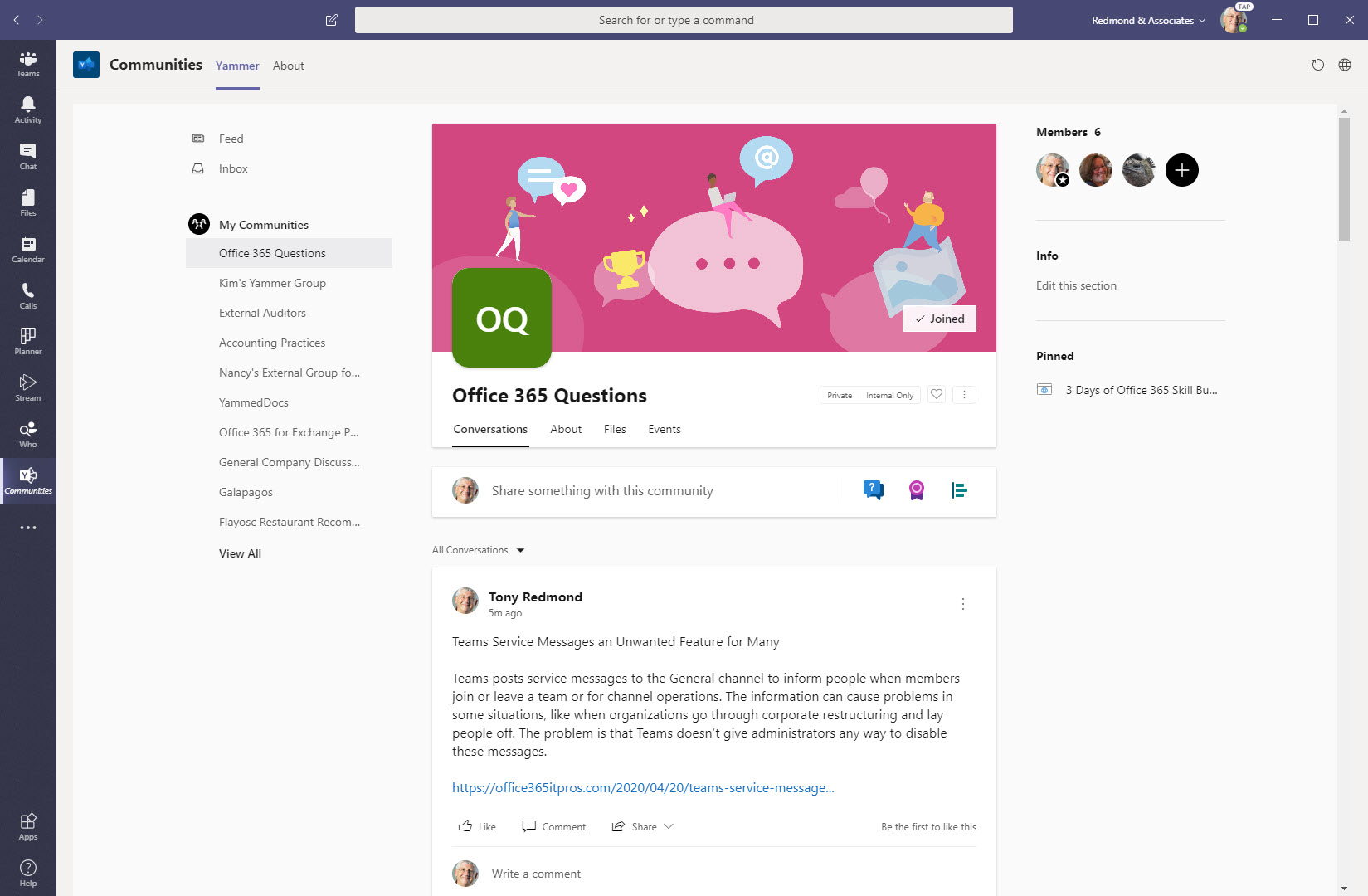
Microsoft has released the Communities app for Teams. The app integrates Yammer into Teams as a pinned app or in a channel tab. The pinned app mode is most functional, even if the channel mode includes a Share to Channel option. Overall, it’s a nice integration, which begs the question as to when the same might be done for OWA?
Teams posts service messages to the General channel to inform people when members join or leave a team or for channel operations. The information can cause problems in some situations, like when organizations go through corporate restructuring and lay people off. The problem is that Teams doesn’t give administrators any way to disable these messages.
PowerShell is a great way to get work done with Office 365 data. The downside is that PowerShell can sometimes be slow, which is why we look for ways to speed things up, especially when dealing with some of the “heavier” cmdlets like Get-UnifiedGroup. The good news is that switching loops to use the ForEach method can speed things up. The bad is that you might only squeeze an extra 5% performance out of your code. Is that enough to bother? Your call…
Office 365 services are now available in the two Norway datacenters in Oslo and Stavanger. The new datacenters join several other “Go Local” country-level regions around the world.
Need to be noticed in a Teams meeting? You can now raise your hand (virtually) to attract the attention of meeting participants. No one might notice, but at least you’ve tried. To some, this might be a small feature. To others, like teachers facing large classes, it might be a real boon.
Recent developments sees the ability to stop Teams users updating their photos by enforcing controls in OWA mailbox policies. Organizers can stop Teams meetings without waiting for everyone to leave with a new End meeting option in the meeting menu. Both changes are rolling out.
Yammer networks can be in any of three modes. The most modern is Native mode for Microsoft 365, which is where Yammer can use many Office 365 features. Although I am not a Yammer expert by any stretch of the imagination, I decided to move my tenant’s Yammer network into a brave new world. Here’s what happened.
The SendAs audit event is logged when someone uses the send as permission to send a message from an Exchange Online mailbox. The events are stored in the Office 365 audit log and can be found there with an audit log search. However, things aren’t as straightforward as they are on-premises because some other types of delegated messages turn up in searches. Fortunately, we have a script to help.
Microsoft 365 Business Premium customers will benefit from the provision of Azure Active Directory P1 Premium licenses. All good, but what about the Office 365 E3 tenants who pay the same monthly fee? Many enterprise tenants could use the features licensed by Azure Active Directory Premium P1, but they’ll have to pay $6/user/month to get the same benefit.
The Plenom Busylight is a small LED light that plugs into a USB port on your computer and changes color to reflect your presence status in Teams, Skype, Zoom, Jabber, or several other UC clients. It’s well worth the price to signal when you’re busy to people whom you share your home with.
In a moment of levity to lift the current situation, we discuss the wide range of themes offered by Office 365 to users. People can choose from 49 different themes to customize the online apps. You can go crazy with something like Super Sparkle Happy, display your love of cats, or choose a simple color. Once chosen, you should see the same theme across all the Office online apps. Except Teams, which does its own thing.
Despite many hints that Teams will soon be able to use custom backgrounds in meetings, Microsoft hasn’t shipped the feature yet. Some users are trying out software like Snap Camera, and the experience is highlighting some issues that companies might face if employees use custom filters without guidance.
We’re going to tape an episode of the Office 365 Exposed podcast at 20:00 UTC on April 2 and everyone can join the Teams meeting we’re using to tape the podcast. There’s lots to talk about, including Microsoft’s decision to make Ignite 2019 virtual.
The swelling interest in Teams has driven interest in online meetings. The recording generated from Teams meetings end up in Stream, but how much storage is consumed by these recordings? Stream will tell you an overall figure, but you won’t know how much storage is consumed by individual videos or who’s taking up all the space.