Embedding external content in modern SharePoint Online (SPO) pages is a really easy task using Microsoft’s out of the box Embed webpart. In the WebPart settings panel we can add the external content URL (such as a YouTube video) or by using the standard <iFrame> HTML tag: In the event we want to add a …
Read More “How to Embed External Content in Modern SharePoint Online Pages”
Rights management and encryption are likely to be a much more common Office 365 feature in the future. Sensitivity labels makes protection easy for users to apply through Office apps. The downside is that protection makes content harder to access for some Office 365 and ISV functionality.
Exchange Online distribution lists can be used to populate the membership of Office 365 Groups or Teams by applying a little PowerShell magic. Here’s how.
A question asks how to remove a bunch of emails from a shared mailbox. You can use OWA to do the job, especially with its Cleanup Mailbox option, but perhaps some administrative action is needed.
A reader asked if it is possible to add an administrator account to every Office 365 Group. This feature doesn’t exists OOTB, but it’s an easy task to script with PowerShell.
Microsoft is now rolling out the “Recent” view in OneDrive for Business to expose the set of recently-accessed documents for a user.
Teams offers a number of ways to create new teams, which is good. However, if you create a new team with PowerShell, make sure that you add the team owners to the members list as otherwise they won’t be able to access Planner.
On Wednesday, November 28, Tony’s speaking about Office 365 Data Governance at the European SharePoint Conference in Copenhagen, Denmark. The topic is interesting, if only because its source material changes all the time.
When a problem arises, it’s good to know what user accounts are affected. In the case of the recent MFA outage, the need existed to report the list of accounts that were MFA-enabled. Here’s how to do the job with PowerShell.
Microsoft’s Azure-based multi-factor authentication (MFA) service experienced a service outage on November 19. Does this mean that we should disable MFA for accounts?
The availability of Azure Information Protection and Office 365 sensitivity labels allow tenants to protect important and confidential files. That’s nice, but it’s even better when you know what files are protected. Here’s how to use PowerShell to create a report about those files.
Not everyone likes writing JSON files, so when the time comes to customize a site design or site script for SharePoint Online, it’s a relief to find that a visual tool is available for the job.
Microsoft has updated the Forms application with the ability for a form owner to move a a form from their personal space to an Office 365 Group. It’s a small but good improvement.
Roughly a month after our last update, we’ve issued update #8 for Office 365 for IT Pros (2019 Edition). It’s a big update with changes for 14 chapters. Please download the updated content soon!
A recent correspondent asked how to find inactive distribution lists in Exchange Online. We didn’t have a good answer in the book, so here’s some PowerShell code to do the trick.
Following a Dutch report saying that Office 365 might violate GDPR, some thoughts about how to restrict some of the flows of information from an Office 365 tenant to Microsoft.
The latest version of the Teams desktop and browser clients support the creation of dynamic teams based on dynamic Office 365 Groups. The functionality is welcome, as long as you can pay for it as every member who comes within the scope of a query used for a dynamic team needs an Azure AD P1 license.
Microsoft is working on tools to move email, calendar, and contacts from G Suite to Exchange Online with availability in Q2 2019. It’s hardly a surprise.
Office 365 doesn’t include a way to export a list of Teams in a form that can be imported by Power BI, but PowerShell makes it an easy task to accomplish. Here’s a script to help solve the problem.
Team owners can set the picture for their teams, but can tenant administrators do the same thing? As it turns out, no. But there’s a reason why.
Microsoft has made the intelligent features of Stream available to all Office 365 commercial customers, meaning that you can now luxuriate in closed captions, automatic transcripts and deep search, and face recognition.
Microsoft has launched Privileged Access Management (PAM) for Office 365. The name’s incorrect because PAM only works for Exchange Online right now. PAM is based on RBAC, which is good, but is the implementation too Exchange-centric?
Microsoft’s grand plan to send helpful emails to Office 365 users hit a roadblock when customers said “No thanks” to the idea. Microsoft has now taken the plan back for mature reflection. Does this kind of initiative reflect a certain arrogance on the part of Microsoft?
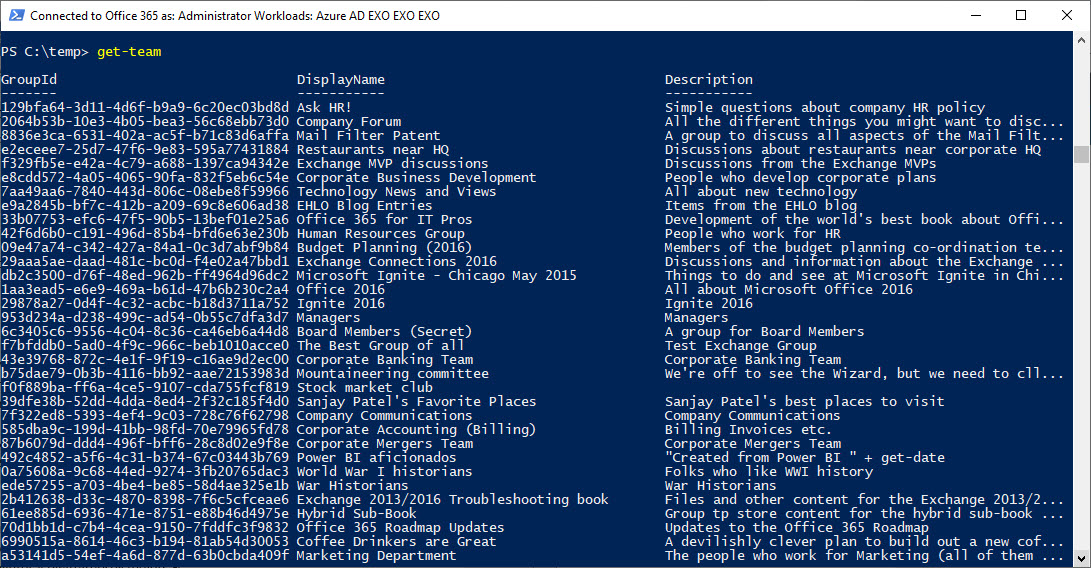
The new version of the Teams PowerShell module (0.9.5) supports a Get-Team that’s actually useful because it can return a full list of teams in the tenant. But there’s still some work to do…
The Microsoft Graph developers and some other folks inside Microsoft have launched a new series of short blog posts to help people become acquainted with the Graph. It’s a nice idea, and one that’s worthwhile to read.
By default, the Groups policy for an Office 365 tenant allows group owners to add guest users to group membership. You can block this access if necessary, but it’s probably not what you want to do as blocking brings guest access to a complete halt across the tenant.
Exchange administrators are accustomed to looking through mailbox audit logs to find details of events. Those same events are in the Office 365 audit log, so that’s the place to go look for information, like when you want to find out who sent a message from a shared mailbox using the SendAs permission.
Azure Information Protection rights management templates now support the Any Authenticated Users permission to allow Office 365 users to share email and documents with anyone who can authenticate with Azure Active Directory or has an MSA account or uses a federated service.
Backup vendors say you should definitely use their products to protect your valuable Microsoft 365 data. Backup products can do a good job, but the nature of Microsoft 365 creates many challenges at a technical level. A lack of APIs is the most fundamental issue, but the connected nature of Microsoft 365 apps is another.
Microsoft will retire the Windows S client for Teams on November 29, 2018. The decision to double-down on the Electron-based client is probably due to the fact that not many people use Windows S.
Do you need to remove some offensive or otherwise doubtful material from Teams? If the original author won’t do the right thing, the team owner or an Office 365 administrator might have to step in to do the right thing.
When you impose a block on certain domains, you’d like to think that applications like Teams will respect that block. As it turns out, if you have some lingering guests in your Azure Active Directory, the B2B collaboration policy might not be as effective as you’d hope.
Office 365 offers different ways to apply encryption to important messages. When those messages hold sensitive data known to Office 365, like credit cards or passport numbers, we can define a transport rule or DLP policy to protect outbound email automatically. And while you can define rules and policies through the GUI, PowerShell is available too.
If you run a hybrid Exchange deployment, you probably have some on-premises distribution lists that you’d like to move to the cloud. Office 365 offers no way to do this, so it’s up to PowerShell. Instead of starting from scratch, you can use a script created by Tim McMichael of Microsoft and amend it to meet your needs. PowerShell is just great.
On October 12, Microsoft and Adobe launched the public preview of the native integration of Azure Information Protection for PDF files. Knowledge about protection is built into the latest version of the Acrobat reader, meaning that third-party tools are no longer needed to process protected PDFs.
Office 365 continues to grow and has now reached the lofty heights of 155 million monthly active users. Just how long Microsoft can keep growing its cloud services is the question that no one can answer!
Microsoft has released a preview of the cmdlet set to allow tenants to create and manage protocol authentication policies for Exchange Online. It’s a great chance to disable basic authentication and reduce the attack surface for password spraying.
Tony spoke about “Can Teams Replace Email” at the Modern Workplace Conference in Paris on October 17. Here’s a sketch note about what he said and a copy of the slides.
Microsoft has released a nifty Network Testing Companion to help Office 365 admins validate that their network can support the deployment of Teams and Skype for Business Online.
Microsoft has updated its retention period for Office audit records from 90 to 365 days, but only for accounts with Office 365 E5 licenses. On another front, the problem with truncated audit records for Azure Active Directory events still persists.