Over the next few months, Tony will speak at a number of small but intense technology conferences. The nice things about these conferences is that attendees and speakers mingle much more than they do at the uber-conferences. If you feel like coming along to The Experts Conference, ShiftHappens, the European Collaboration Summit, or Experts Live Norway, you can learn more about Office 365 and associated technologies without going through the wildness that Ignite can be at times.
The modern SharePoint Admin Center introduces the ability to rename the URLs for SharePoint site names. This responds to a longstanding customer request and makes it possible for site names to reflect what users see elsewhere in Office 365 groups or Teams. It’s a small but welcome change in the fit and finish category.
Microsoft has integrated its Office Lens technology into Outlook for iOS to give users the ability to capture and include an image in messages in a very easy manner. Office Lens is more than another camera app as some Microsoft Research smarts are used to smoothen and clarify images before saving in a variety of formats, now including an Outlook message.
Depending on your tenant’s configuration and the applications in use, the prospect of a tenant-to-tenant (T2T) migration might be appealing or a horror story. Applications like Quadrotech’s Cloud Commander are designed to help move data between tenants. In this video, Tony Redmond and Mike Weaver discuss some of the complexities involved in T2T projects. The program is 15 minutes long.
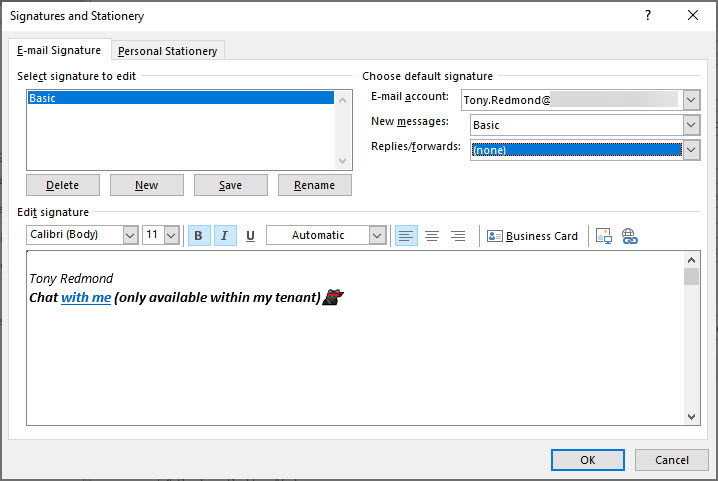
Teams deep links are probably not something you chat about a lot, but they can be used to start off a personal chat. In this post, we discuss how to insert a deep link in an Outlook or OWA signature so that recipients can contact you to follow up a topic started in email. It’s a quirky detail about Teams that might be interesting for you.
At their Q3 FY19 earnings call, Microsoft CEO Satya Nadella said that Office 365 is now used by 180 million monthly active users. Office 365 is now growing at more than 4 million users per month. The earnings call also noted success for Enterprise Mobility and Security and the Outlook mobile client, both of which are now used by more than 100 million people.
The latest build of the Teams clients (desktop, browser, and mobile) include the ability to remove a participant from a group chat. This is a much-requested feature that’s taken surprisingly long to deliver, but now you can have fun adding and removing people to your heart’s desire. It’s nice to have a chat and it’s even better if you can control who you chat with.
Outlook for Windows (ProPlus or click to run) now boasts settings to allow users to schedule meetings and appointments to end some minutes earlier than expected. Brian Reid is very excited by the prospect, but we’re not sure if this qualifies as one of Ståle Hansen’s famous lifehacks. In any case, ending meetings early won’t solve the problem of badly-organized or managed meetings or how people behave during meetings, but it might give you a quiet feeling of satisfaction to have a neater calendar.
No one can say that the role of an Office 365 admin is static. In fact, it changes all the time as new technologies appear or Microsoft changes existing applications. This video featuring MVPs Paul Robichaux and Tony Redmond explores the changing role of Office 365 Admins, and sometimes it even makes sense.
Microsoft has released the GA version of the Azure Information Protection client, which reads information about Office 365 sensitivity labels and policies from the Security and Compliance Center. It’s one more step along the path to making it easy for Office 365 tenants to protect their data. Work still has to be done, but at least we can see light at the end of the encryption tunnel.
Microsoft announced a new migration experience from Google G Suite yesterday, which is nice. Under the covers, the venerable Mailbox Migration Service (MRS) does the work to extract mailbox data from Gmail using IMAP4 and moves it to Exchange Online. But after the move is done, there’s still lots of work to do to help users make the cultural change to their new mailbox in the cloud.
The ThirdPartyFileProvidersEnabled setting in OWA mailbox policies controls if Exchange Online mailboxes can access services like Drop and Dropbox for attachments. Office 365 tenants need to decide if they want to allow this kind of access. There’s both good and bad in the feature, but it’s easily turned off if you feel the need.
The Teams Admin Center now boasts the ability to delete teams and (if you don’t want to get rid of them altogether) archive teams. And unarchive teams back into use. All is good, even if Microsoft is making slow progress at building out Teams management functionality. Some of the slowness is due to dependencies, some because of other factors.
Sometimes Office 365 can be infuriating. My latest tribulation came in the form of missing retention labels, which disappeared from SharePoint Online without any reason for two weeks. Some labels returned due to auto-label policies, but any applied to documents manually had a vacation somewhere in the bowels of the services. It wasn’t a good experience.
The Office 365 for IT Pros writing team don’t pay too much attention to ratings we receive on different sites. However, we love getting comments to tell us how we can improve. If you’ve got something to share with us, please send a comment on this site or on Facebook.
The Office 365 Admin Center offers the option to bulk-create user accounts. Loading up a CSV file with details and having it processed is simple enough, but the resulting accounts need some work before they are fit for purpose and ready for people to use. Here’s how the bulk creation process works and why we think it has some flaws.
Every Office 365 group (and team) has a SharePoint site. But how to find the URLs of all the sites used by teams in a tenant. One PowerShell answer came from Syskit, but it’s an old technique and we can do better now by fetching a list of teams in the tenant and then retrieving the URL for each team-enabled group.
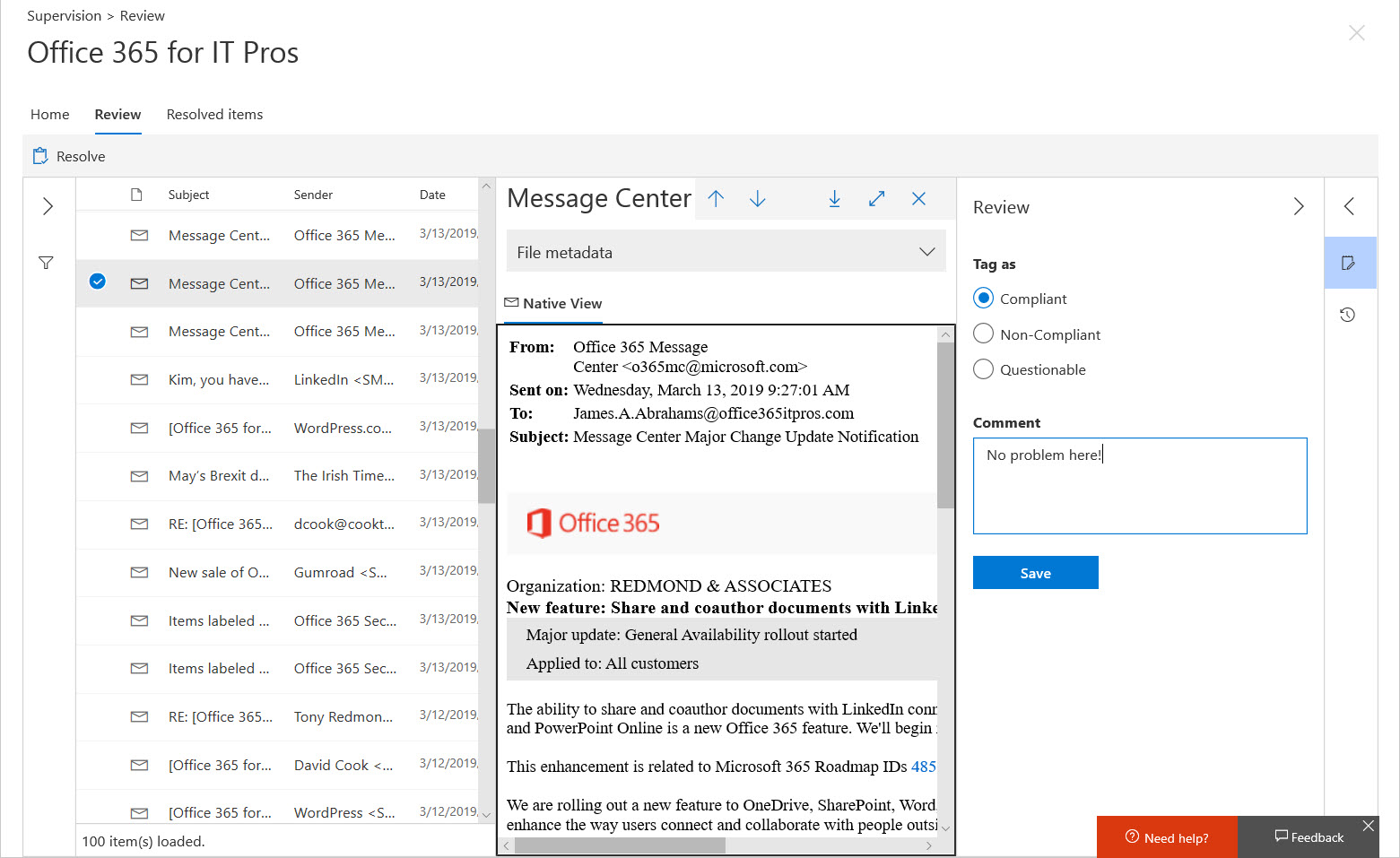
Although Office 365 supervision policies are intended to monitor a subset of user communications, usually involving specific groups of people, you might want to use a policy to monitor all email. In that case, how do you make sure that your policy has everyone in scope? The problem is that supervision policies don’t support dynamic distribution lists, so you need to do some work to build and maintain a distribution list containing all user mailboxes.
Last week, we taped episode 14 of the Office 365 Exposed podcast in Building 27 of Microsoft’s HQ in Redmond. Topics covered include battling attacks on Exchange, the need to upgrade old Exchange versions, Teams announcements at Enterprise Connect, and how the base Office 365 workloads handle retention storage. We think it’s an interesting episode. Get it from iTunes now!
Office 365 content searches now support a hard-delete (permanent deletion) option for the purge action, but only for mailbox items. You can purge up to 10 items at a go. If you have more to purge, you just have to keep on purging until everything is gone. Or use the Search-Mailbox cmdlet, which keeps on proving its usefulness to administrators who need to remove lots of mailbox items quickly.
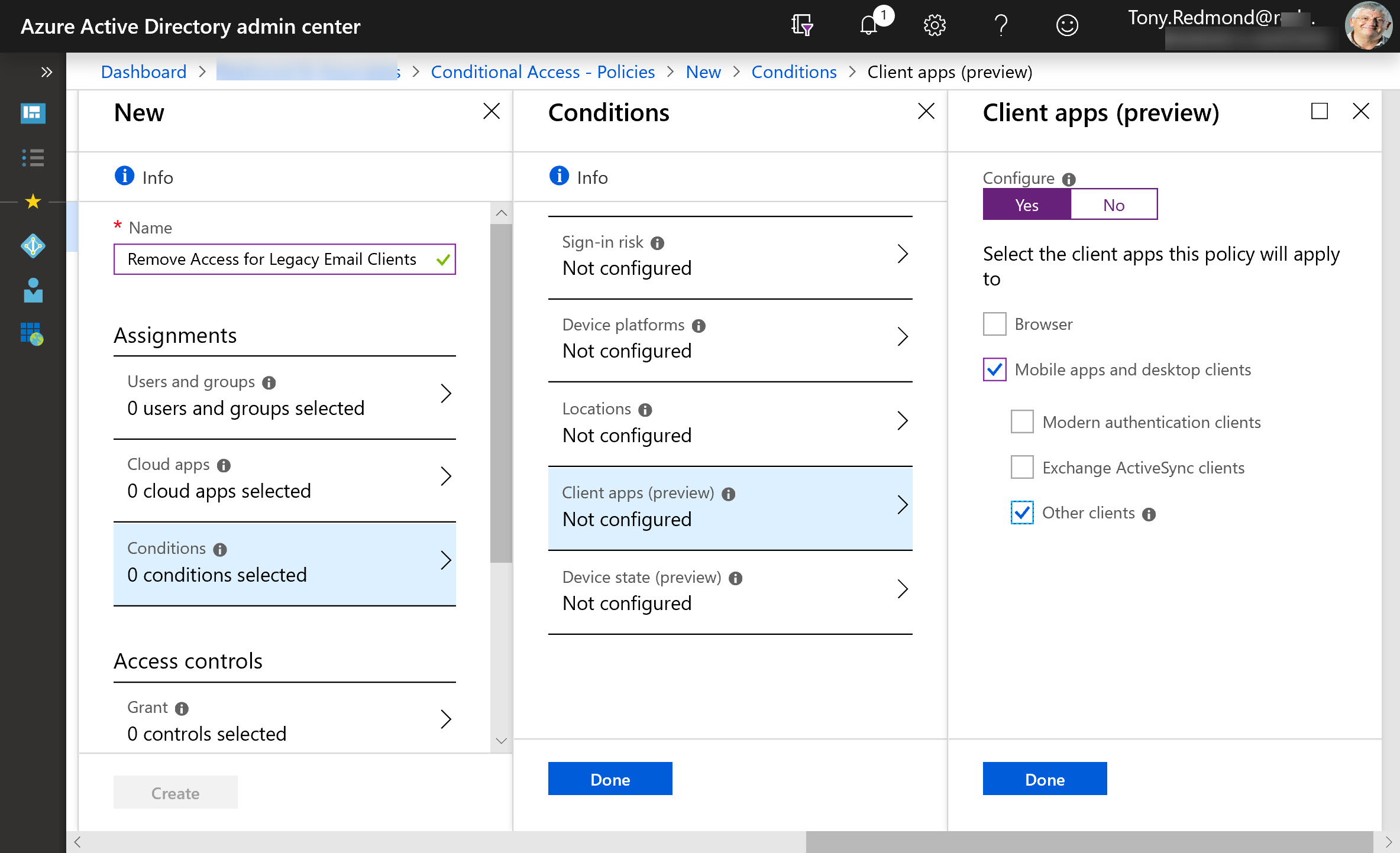
Exchange Online protocol authentication policies control what protocols a user can connect to mailboxes with, but it would be much better if we didn’t have to worry about some old and insecure protocols. Azure Active Directory gives Office 365 tenants the chance to clamp down on IMAP4 and POP3 connections and close off some of the holes that attackers try to exploit. Microsoft says that this can lead to a 67% reduction in account compromises, so that’s a good thing.
The March 2019 updates for the Office 365 for IT Pros eBook are now available for EPUB/PDF and Kindle versions. EPUB/PDF subscribers can download the updated files from Gumroad. Getting the updates for Kindle is slightly more difficult, but it’s possible and explained in our FAQ. Twelve of twenty-four chapters are updated in this release, so please take advantage of our work and download the updates now.
Microsoft To-Do now boasts the ability to process messages flagged by Outlook as tasks. It’s a great way to handle complex tasks that arrive in email, so Office 365 users might like to give To-Do a second look. The steps feature makes it very easy to build checklists of stuff that needs to be done to accomplish tasks.
Microsoft has announced that Planner now boasts the ability to copy a plan. Apparently, the idea is to save time by setting up plan templates that you can reuse. Office 365’s task management app might not get as much love as other apps, but this is a useful set forward. Only users who are allowed to create new Office 365 groups can copy plans.
The Office 365 Groups Naming Policy is now generally available. The policy has taken nearly two years of preview to not get very far, but at least it’s now an official part of the service. Microsoft considers the naming policy to be an Azure Active Directory Premium feature. Many customers might think differently, especially because the naming policy must be implemented through PowerShell and can easily be mimicked through PowerShell. And of course, Exchange Online’s distribution list naming policy is free.
Microsoft announced that the era of favorites and following is over for Teams. The new way is to show or hide teams and configure notifications for channels. Apparently, people found the old terminology confusing. Hopefully the new world of Show/Hide and Channel notifications will be more reassuring.
In a sign of how automation based on signals gathered by Office 365 will emerge to help administrators do a better job, the preview of the new Admin Center offered to create a DLP policy to protect some sensitive information that I had clearly overlooked. Well-intended as the portal was, its efforts to create the new policy failed. That’s not really important – it’s the glimpse into the future which is.
New data about the number of Slack and Workplace usage gives the chance to compare how Microsoft is doing with Teams. And the answer is that things seem to be going well, largely because Teams is growing off the huge Office 365 base. With 155 million users (the last figure) and 3 million more added monthly, Teams has a lot more to go after in the Office 365 installed base.
If you work with Office 365 through PowerShell, you probably have your own script to connect to the various services. If you don’t want to write your own script, you can download one from GitHub or the TechNet Gallery. This article covers two that you might like to try, including one with a GUI to choose which Office 365 services it should connect to.
PowerShell is hugely useful when the time comes to automate Office 365 processes. Other tools exist that can help, including Flow. Maybe it’s the right time to consider Flow, especially when it is highly capable of knitting together different Office 365 components to get work done.
Microsoft announced that the Office 365 E3 and E5 plans will receive new Information Protection licenses. They’re preparing for the introduction of sensitivity labels and the increased use of encryption to protect access to content in Office 365 apps like SharePoint Online, Exchange Online, OneDrive for Business, and Teams. You don’t have to do anything to prepare for the new licenses, but it’s nice to know what they are and how the licenses are used.
SharePoint Online supports the ability to create and publish a news digest from news items published on a site (or sites associated with a hub site). It’s a great way to spread information within an Office 365 tenant.
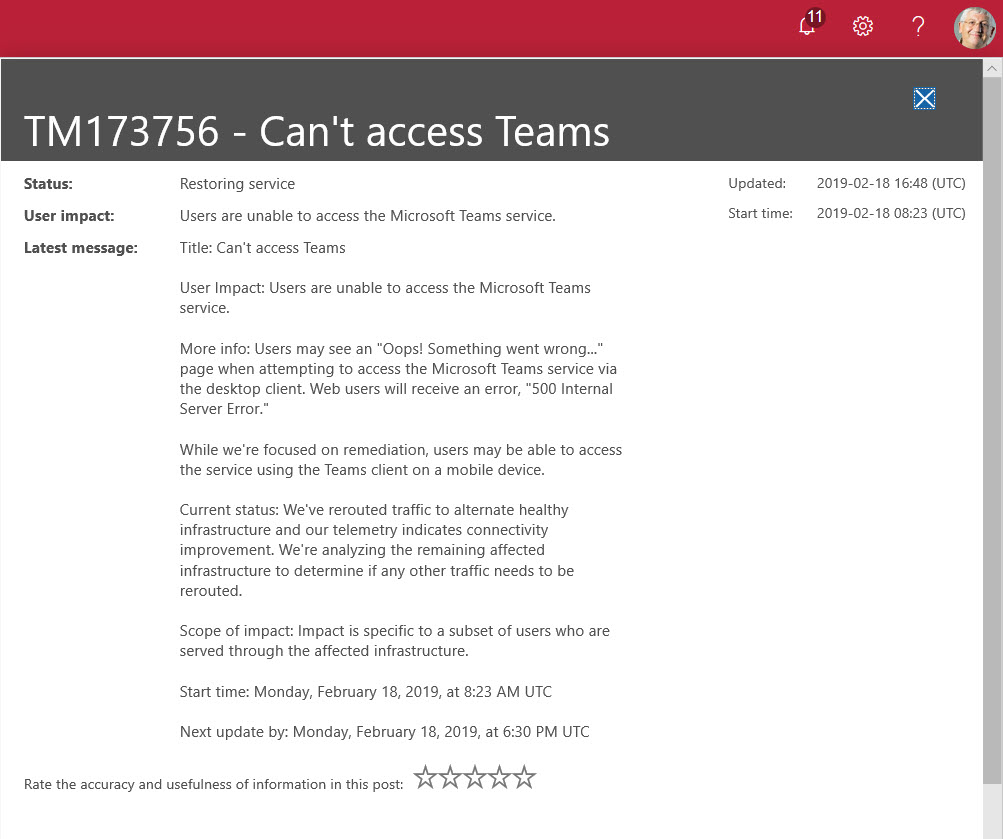
Microsoft Teams suffered its first major worldwide outage on 18 February 2019. Users reported a failure to connect because Teams couldn’t authenticate them. The Post-Incident report for TM173756 revealed an issue with the Azure Key Vault. What’s more interesting is that the issue affected users in multiple Office 365 datacenter regions, which is not good.
In one of those interesting (but possibly worthless) facts discovered about Office 365, we find that audit records are captured for Teams compliance records written into Exchange Online group mailboxes. The Search-UnifiedAuditLog cmdlet reveals details that we can interpret using some techniques explained in Chapter 21 of the Office 365 for IT Pros eBook.
A recent Petri.com article set out the case that the technical lead for Office 365 deployments is best found in the ranks of people experienced with Exchange.The uphot was a flurry of tweets where people who worked with SharePoint and Skype explained their (strong) feelings on the matter. The upshot was an online debate to explore the attributes of people who lead successful Office 365 deployments. You can listen to a recording online.
Office 365 changes all the time, which is good because it keeps the Office 365 for IT Pros writing team busy and happy. Discussions this week included Microsoft’s response to a Dutch DPIA, the effect large Teams have on Yammer, how Exchange Online validated a fix to a security problem, and graphics to help understand the components of the Microsoft 365 E3 and E5 plans.
After a brief hiatus, the recording for episode 13 of the Office 365 Exposed podcast is now available. We think it includes some interesting topics and the arguments aren’t too heated. See what you think and let us know in the comments.
Some backup vendors think that corruption can lead to data loss within Office 365. The possibility exists, but the page patching mechanism for databases incorporated into Exchange Online DAGs makes corruption a lot less likely, especially when mailboxes are protected by four database copies and Exchange applies many other techniques to ensure the consistency of the databases.
Microsoft has released details of an Exchange Online transport rule to encrypt outbound email containing sensitive data types like credit card numbers. The rule works (after fixing the PowerShell), but needs to be reviewed and possibly adjusted to meet the needs of Office 365 tenants.
According to Microsoft’s FY19 Q2 results released on January 30, Teams is now used by 420,000 organizations. That’s a strong growth rate over the 329,000 number given at Ignite 2018. And with Office 365 still growing, there’s plenty of room for Teams to expand.